0
Patients randomized, 2:1
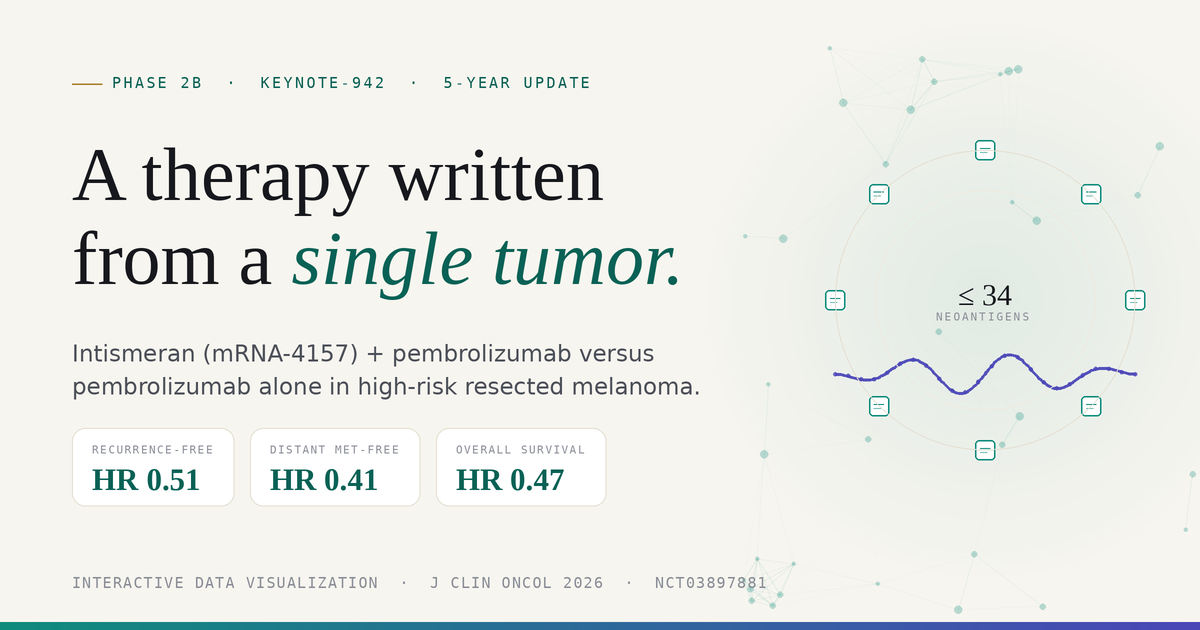
Intismeran autogene (mRNA-4157) — an individualized neoantigen therapy encoding up to 34 patient-specific mutations — plus pembrolizumab, versus pembrolizumab alone, in high-risk resected melanoma.
Even after complete resection of stage IIIB–IV cutaneous melanoma, micrometastatic disease drives relapse. Adjuvant anti–PD-1 helps — but in this trial, with pembrolizumab alone an estimated 49.1% of patients remained recurrence-free at four years. Roughly half recurred.
KEYNOTE-942 asked a mechanistic question: could a vaccine built from each patient's own tumor mutations broaden and deepen the checkpoint-inhibitor response?
Checkpoint blockade and neoantigen vaccination act on different steps of the anti-tumor immune response. Toggle between them to see how each contributes — and why the combination is more than the sum of its parts.
The tumor's mutations are its fingerprint. Intismeran turns that fingerprint into an instruction set the immune system can read. Watch the pipeline, or step through it.
Primary endpoint: RFS · Secondary: DMFS, safety · Exploratory: OS, biomarkers, antigen-specific T-cell responses. Treatment continued to maximum doses, recurrence, or unacceptable toxicity.
Select an endpoint, then hover or drag across the curves to read the estimates and the number of patients still at risk at any time point.
Serial TCR sequencing (baseline → cycle 2 → cycle 5 → long-term) tracked how the T-cell repertoire changed. The combination expanded new clones — and expansion tracked with staying cancer-free.
Adding the vaccine increased low-grade, self-limited reactions but did not produce the severe toxicity seen when two systemic immunotherapies are combined.